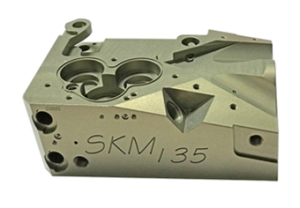
What are the working principles and applications of five-axis machining?-2
Detailed Description: 5 Axis Machining – Working Principle & Applications
5 Axis Machining is an advanced CNC machining mode with outstanding advantages in mechanical manufacturing, especially for processing parts with complex geometric shapes. Its working principle and main applications are as follows:
I. Working Principle
Based on the 3D coordinate system, 5-axis machining realizes high-precision part processing by controlling five coordinate axes simultaneously, including three linear axes (X, Y, Z) plus any two rotary axes (A, B, C).
The coordinate movement can be completed by the table or the cutting tool, and all directions are defined by the relative motion between the tool and the workpiece. 5-axis linkage supports simultaneous linear interpolation of any 5 coordinates, enabling efficient and precise machining of complex-shaped parts.
II. Main Applications
Aerospace Industry: Widely used for processing fuselage parts, turbine components, impellers and other free-form surface parts with high precision and complex structure requirements.
Automobile Manufacturing: Applied to produce complex components such as engine cylinder blocks and gearbox housings, meeting high-precision and high-efficiency demands of auto parts production.
Mold Making: Provides high-precision machining for mold cavities and cores, greatly improving mold manufacturing accuracy, surface quality and service life.
Precision Machinery: Used to manufacture complex components for precision instruments, medical equipment and high-end mechanical devices with strict precision standards.
Other Fields: Also widely applied in medical devices, robotics, defense, shipbuilding, new energy and compressor industries, solving difficult machining tasks of complex curved parts, deep cavities and overhang structures.